About Me
First Encounters with Music and Sport
My story begins in 1966 in Mexico City, where I was born into a middle-class family. Being the eldest of five siblings, I grew up in an environment where music and sport intertwined with our daily life, though not formally. My earliest musical memories are linked to my parents' love story — they met at a dance. My mother, an educator, and my father, a civil engineer with a passion for classical music, planted in me a deep appreciation for harmony and rhythm.
The musical influence of my family extended back generations, embodied in the figure of my great-grandmother, Mamá Chole, a loving presence with whom I had the privilege of sharing 19 years full of lessons and melodies. She and my mother, singing duets, taught me from an early age that music was more than sound; it was a language of the soul and a family bond. Sundays at home were steeped in Beethoven symphonies and Italian opera, courtesy of my father, who had also inherited a love of serenading from his youth.
Though we were not a particularly athletic family, my parents enrolled me in swimming lessons at age five, marking the beginning of my relationship with physical activity and personal growth.
This is where the first foundations of my method began to take shape, even though I didn't know it yet. The love of music and the discipline of sport were influences that, years later, would lead me to develop a philosophy based on the combination of precise technique, self-discipline, and a deep understanding of the mental processes that enable long-term learning.
Adolescence and Youth: Exploring Passions
When I turned 8, we moved to Cuernavaca, and my life took a turn that would bring me even closer to music and sport. At my new school, I joined the rondalla, where I learned to play and sing, and discovered the value of chord diagrams and American notation.
During my first year in Cuernavaca, I also enrolled in judo, but it was basketball that truly captured my athletic spirit. Under the guidance of Coach Jaime, I learned invaluable lessons in dedication and teamwork. Music, however, kept calling. The generosity of my grandmother Amparo gave us a Petrof upright piano, marking the beginning of my formal musical education with my uncle Carlitos.
Although my uncle suggested I should consider studying at the National Conservatory of Music, this idea did not resonate with me or my parents at the time. Instead, I continued exploring my passion for music through school song festivals and my growing guitar skills, inspired by a classmate who introduced me to Cuban trova and the music of Silvio Rodríguez.
This stage represented a true expansion of my vision of music. Here I began to understand the importance of technique, but also how body and mind needed to be in perfect synchrony to achieve real mastery of an instrument. These ideas would eventually be integrated into my methodology, which would later incorporate concepts of proprioception and neuroplasticity as pillars of musical development.
Musical Rebirth and Academic Formation
At the crossroads of adulthood, I found myself torn between my aptitude for the exact sciences and my passion for music. Following the advice of those around me, I chose to study chemical engineering at UNAM, temporarily pausing my musical journey.
However, it was during my university studies that a chance encounter with the Manuel M. Ponce international guitar competition reignited my passion. Meeting Maestro Mario Beltrán del Río and joining his workshop was a decisive moment that redefined my musical path.
Under Mario's guidance and later that of Maestro Humberto Hernández Medrano, a student of Dmitri Shostakovich, I immersed myself in the study of music theory, solfège, and composition. Maestro Medrano's workshop covered a broad spectrum of musical theory and practice, from harmony and counterpoint to analysis and musical forms.
This period was key in shaping my method. Maestro Medrano's teachings gave me a deep understanding of musical structure, while my scientific background allowed me to see music differently — almost as a structured system that could be deciphered and perfected through deliberate practice and conscious focus.
Foray into Teaching and Music Production
Shortly after completing my studies, I began teaching lessons based on Maestro Medrano's workshop. Although I did not always have a large number of students, my teaching was enriched by the use of emerging digital tools.
My first income as a composer came through music for a children's story and, later, I had the opportunity to collaborate on the music for a television drama thanks to my friend and fellow workshop member, Jorge Avendaño. Although that project did not meet my expectations, I continued exploring new opportunities, such as composing for a theater production and, finally, my first notable success: the music for the first Honda Accord commercial on national television.
Peak Years in Advertising and the Recording Studio
Over the next fifteen years, I thrived in the world of advertising, working with major brands and establishing my own recording studio, StormStudios, in collaboration with my friend Rodolfo Martínez. This period not only drove my growth as a composer and producer, but also confronted me with the challenges of continuous learning.
It was during a quieter period that, in the company of my friend Salvador González, we decided to search Amazon for books that could fill our knowledge gaps. We acquired The Art of Mixing, a book that transformed my understanding of music production and led me to discover David Lucas Burge's perfect pitch method.
Dedicating a full year to that method and later exploring his relative pitch course, I opened a new chapter in my musical journey. This period was crucial not only in my own development, but also in the formation of my first professional student, Armando García, who would later receive recognition for his contributions to the studio's projects.
Here the idea began to take shape that perfect pitch was not simply a genetic oddity, but a skill that could be cultivated through the right methodology. My research and personal experiences began to align to form the principles that would later become the core of my teaching method.
During this time I began to experiment with the idea of training my ear in a systematic way. These early experiences led me to understand how ear training could shape the brain and improve musical perception just as tangibly as practicing an instrument. This would be one of the fundamental seeds that shaped my approach to absolute and relative pitch in my method.
It was during this stage of my professional career that I had the opportunity to work on some of the most important projects as a composer and producer. I worked for the highest-profile clients in Mexico City, including Televisa and TV Azteca, as well as in advertising for recognized brands such as Honda, Citigroup, HSBC, and Citibanamex. I was also part of renowned producer Pedro Torres' successful series: El Encanto del Águila, Mujeres Asesinas, and El Equipo — the latter two shortly after studying sound engineering with the great Ronan Chris Murphy in Los Angeles.
Transition to the World of Fitness and Bodybuilding
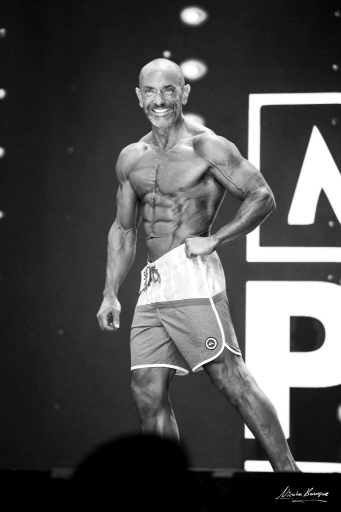
The 2008 financial crisis brought changes to the music industry that led me to gradually step away from composition and explore new interests, such as bodybuilding. Guided by books written by neurologists specializing in nutrition, I began investigating the relationship between brain function and diet.
My transition into the fitness world was driven both by my passion for sport and by the need to protect my hearing health after an incident during my Tae Kwon Do practice. Under the guidance of a nutritionist, I joined her bodybuilding team and eventually took charge of my own preparation.
At age 52, I won the Musclemania 2018 Masters Men's Physique World Championship in Las Vegas — an achievement that demonstrated the power of dedication and perseverance. The physical training process connected with my vision of musical formation. Control over the body, the importance of proprioception, and the discipline of physical training are the same principles that, applied to music, allow us to achieve absolute mastery over our instruments and our auditory perception.
Return to Music Teaching and Methodological Development
Yet music never stopped being part of my life. The opportunity to tutor the son of my friend Julio Flores marked my return to the world of music, this time as an educator. This new role reignited my passion for developing an innovative teaching methodology — a project I have been working on for the past 15 years.
My own journey, from student to professional and now educator, has given me a unique perspective on musical learning and strategies to unlock talent. Through my story, I have learned that you do not need to be a prodigy to achieve musical excellence. With dedication, passion, and the right guidance, anyone can develop extraordinary abilities.
I invite you to join me on this journey of discovery and growth, as we explore together the fascinating world of music and the limitless potential of the human being.