Lesson 5
⏱ ~30 minLesson 5 — Degrees, Chords and Tonality
🎬 Degrees, Chords and Tonality
Before writing in four voices we need a common vocabulary: what the degrees are called, what each one does, what a chord is, and where the idea of tonality comes from. This lesson is explanatory only; it has no assignment for the Virtual Teacher.
Degree names
Each scale degree has its own name. The names are arranged around the tonic: the dominant is a 5th above and the subdominant a 5th below; the mediant is a 3rd above and the submediant a 3rd below.
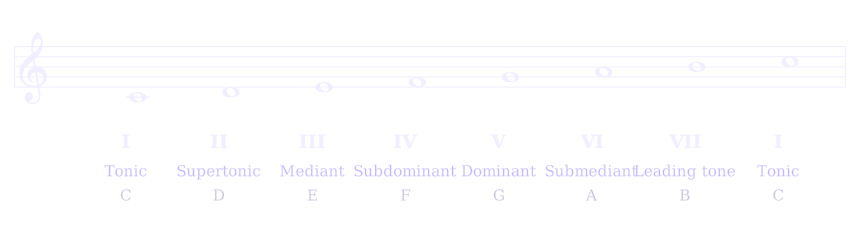
The 7th degree is called the leading tone when it lies a semitone below the tonic, as in the major and harmonic minor scales. When it lies a whole tone below, as in natural minor, it is called the subtonic.
Functions of the degrees
| Function | Degrees | Why |
|---|---|---|
| Tonal or principal | I, IV and V | They sustain the key |
| Modal | III and VI | They decide whether the mode is major or minor |
| Attractive | VII leading tone; IV and VI when they share a chord with the leading tone | They require a special resolution |
| Secondary | II, III, VI and VII | All those that are not principal |
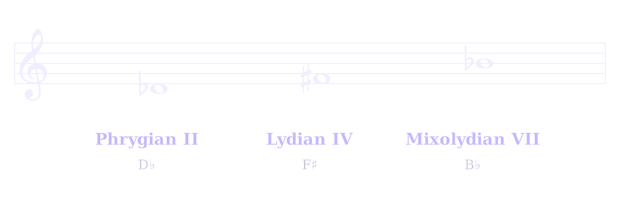
We call a note attractive when its harmonic tendency requires a special resolution. Three altered degrees borrowed from the modes are also attractive: the Phrygian II, the Lydian IV and the Mixolydian VII.
The chord
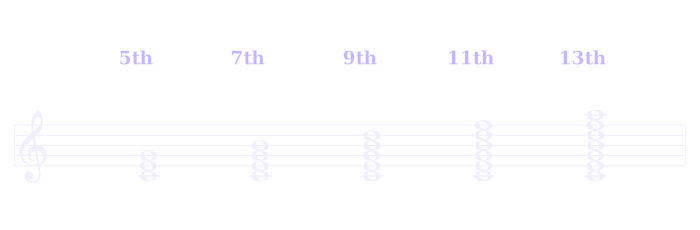
A chord is any simultaneity of different sounds. We build it from a generating sound, the root, by stacking thirds. The chord is named after the interval between the root and its highest note:
| Stacked thirds | Notes | Name |
|---|---|---|
| 2 | 3 | Fifth chord (triad) |
| 3 | 4 | Seventh chord |
| 4 | 5 | Ninth chord |
| 5 | 6 | Eleventh chord |
| 6 | 7 | Thirteenth chord |
Harmony is the part of musical technique that studies both the intervallic structure of chords and the laws by which they are connected.
The harmonies and the harmonic series
Rather than a single harmony, we are interested in "the harmonies": those of each period, genre, style or composer. The harmonic series explains how new intervals were accepted over time. Each stage of history incorporated the next harmonics in the series.
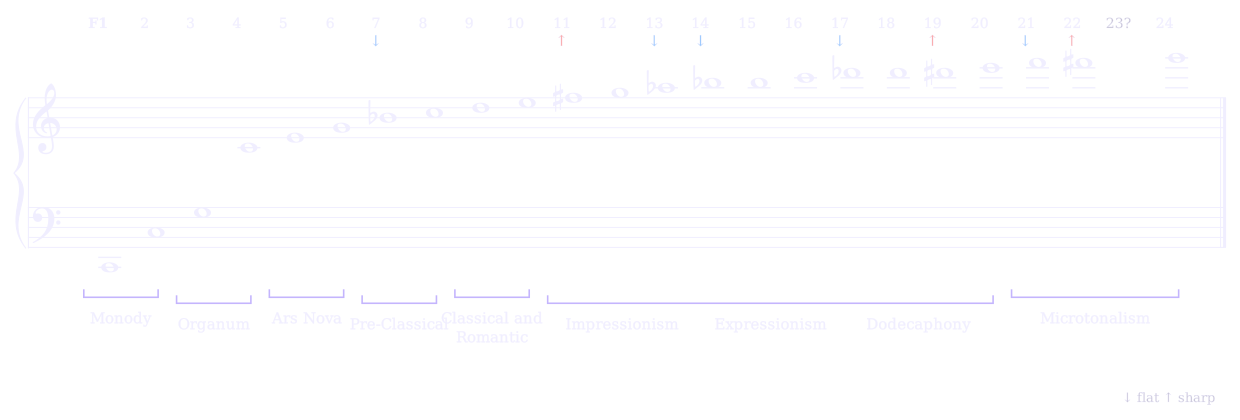
The arrows mark harmonics that sound lower (flat) or higher (sharp) than the tempered note used to write them. The 7th, for example, is a B♭ that sounds slightly flat.
| Stage | Harmonics | Composers |
|---|---|---|
| Monody | 1–2 | — |
| Organum | 3–4 | — |
| Ars Nova (14th century, Renaissance) | 5–6 | — |
| Pre-Classical (16th–18th centuries) | 7–8 | Bach, Handel, Mozart, Beethoven |
| Classical and Romantic | 9–10 | Schubert, Chopin, Brahms |
| Impressionism | 11–20 | Debussy, Ravel, Fauré, Satie |
| Expressionism | 11–20 | Stravinsky, Shostakovich, Bartók, Scriabin |
| Dodecaphony | 11–20 | Schoenberg, Berg, Webern, Hindemith |
| Microtonalism | 21–24 | Carrillo |
Chords of the basic scales
If we take each degree of the basic scales as the root of a fifth chord, we only get four chord types: major, minor, diminished and augmented. A chord is major or minor because of its third, and augmented or diminished because of its fifth. You built all of them in Lesson 4.
Tonal regions
The chords of a scale are grouped into three tonal regions: subdominant, tonic and dominant.
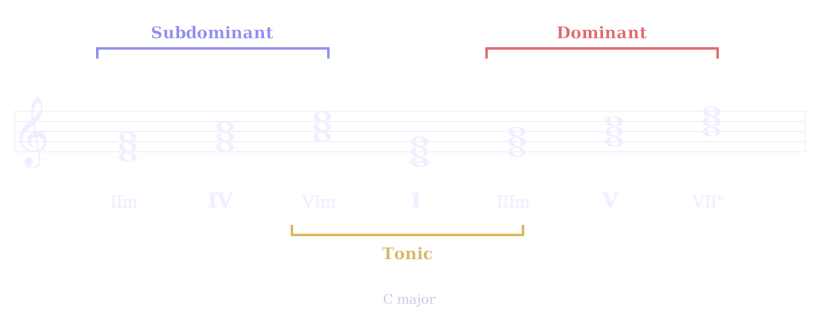
- Each region is represented by a principal chord that gives it its name (IV, I and V), and by two secondary chords a 3rd above and below it.
- The modal chords III and VI belong to two regions: VI to the subdominant and the tonic; III to the tonic and the dominant.
- Chords of the same region can substitute for each other without changing the harmonic sense of a passage.
Tonality
Tonality is the set of relationships, functions and hierarchies that all the sounds of our system adopt around one of them, chosen beforehand as the tonal center: the tonic. To modulate is to replace one tonal center with another.
The altered (or unaltered) notes of a passage show its key. If we order the keys by the order in which new accidentals appear, we find a fixed relationship of perfect 5ths, both between the keys and between the accidentals:
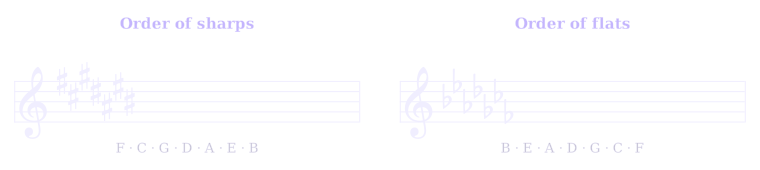
Each key signature serves two keys: a major key and its relative minor, a minor 3rd below. The circle of fifths gathers the 15 major and 15 minor keys. At the bottom, three positions have two enharmonic names (B/C♭, F♯/G♭ and C♯/D♭) with different key signatures.
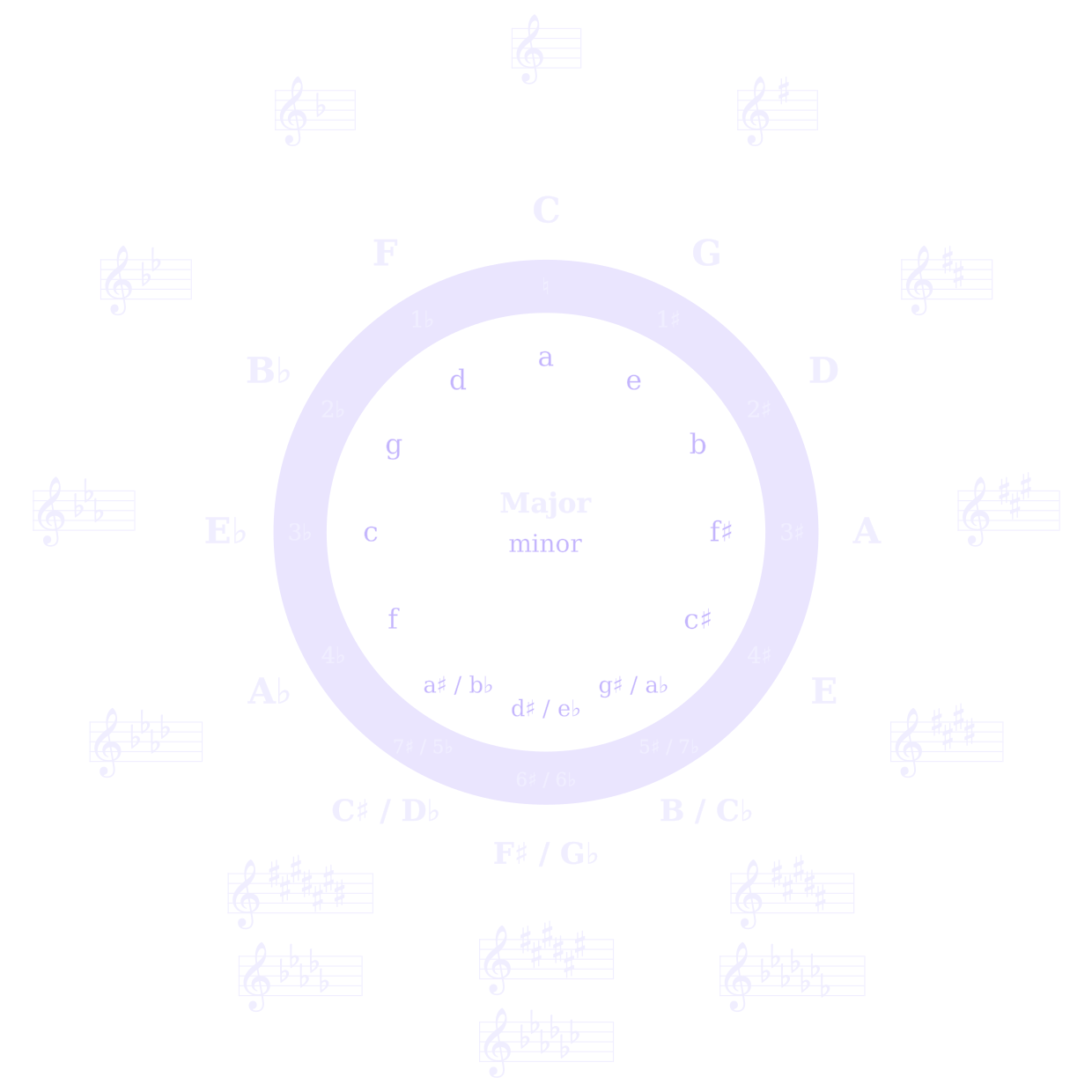
Going clockwise, each key is a perfect 5th above the previous one and adds a sharp (or drops a flat). Going counterclockwise, each key is a perfect 5th below and adds a flat.